

I'm a startup investor and entrepreneur. I spend my time thinking about high-growth businesses and working with founders to support their journey. I also help companies create data-driven strategies, develop compelling products, manage talent, and raise capital. I enjoy building things, cultivating community, and coaching leaders. This site is a collection of some of my thoughts and work. I typically write about startups, venture capital, and leadership.
Latest Thinking

Trey Anastasio is the guitarist and frontman for Phish—a jamband originally from Vermont that has been going strong since 1983. Phish’s trademark is its improvisational style and unique sound that ensures each show is different from the next. This approach has led to an adoring fan base that follows the band from city-to-city each tour. I’m one of them. My time with the band dates back to 1997 when I was still in high school. I believe that Phish is the greatest rock band in history and Trey is the greatest living guitarist. But my love of Trey and Phish is not what this post is about.

01. What is “The Startup Community Way”?
The Startup Community Way is a book I co-authored with Techstars cofounder Brad Feld. It’s a collection of frameworks, principles, and action points that guide and inform practitioners and observers about the key characteristics, behavioral patterns, and basic function of startup communities and entrepreneurial ecosystems. Our thinking is supported by the science of complex adaptive systems, which explains the behavior of inherently unpredictable, emergent phenomena. We apply insights from systems thinking and community-building across many contexts to enable better engagement and more productive outcomes for entrepreneurs.

This article originally published on the Center for American Entrepreneurship Ideas Blog
My new book with CAE Advisory Board member Brad Feld published yesterday. The Startup Community Way: Evolving an Entrepreneurial Ecosystem is essential reading for entrepreneurs, community leaders, policymakers, and other key stakeholders looking to entrepreneurship as an engine of innovation and economic growth. As more cities, regions, and nations embrace entrepreneurship, it is widely recognized that the environment in which a startup operates plays a role in the likelihood of its success. For this reason, the topic of “entrepreneurial ecosystems” has begun to play a bigger role in many economic policy agendas.
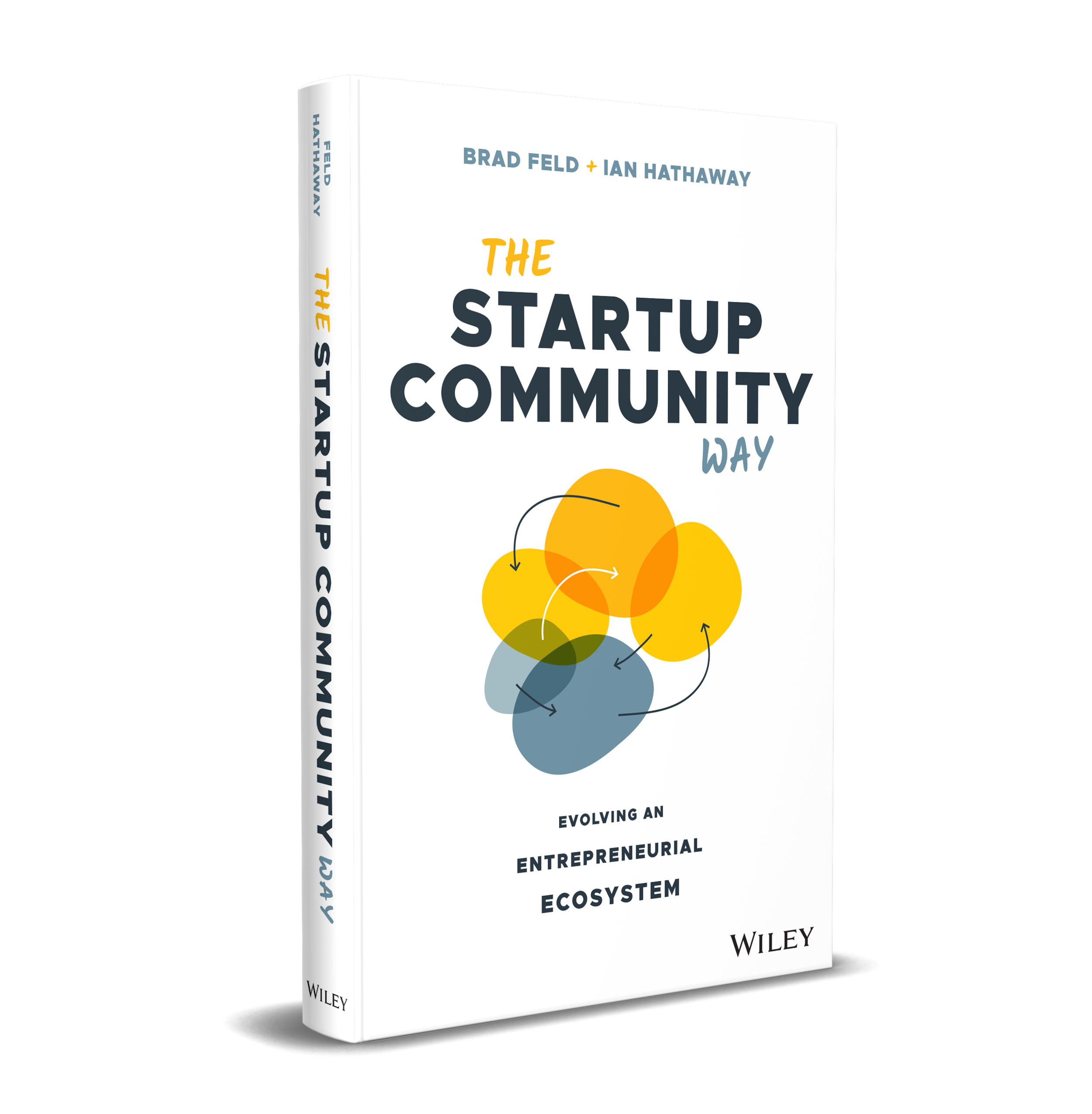
After three eventful years, I’m excited to say that my new book—The Startup Community Way: Evolving an Entrepreneurial Ecosystem, with Brad Feld—is officially available to the public today! It’s my first book, so this is a new feeling. It’s hard to put into words how grateful I am for the experience. I learned so much in the process and developed a large number of meaningful relationships along the way that will last a lifetime. It wasn’t always fun; writing a book of this nature is really hard work. But it was worth it.
I believe that Brad and I have created something that will be useful to many people, not just in entrepreneurship and community-building, but far beyond. Our book is not the final say on the topic of startup communities; it’s the beginning of a conversation. There is more work to do and many other voices to hear from. Like with startup communities, the work is truly never finished. But, I believe we have provided a solid foundation from which many people can benefit and build upon for years to come. I’m proud of our work.

This is a photograph of my dear friend Ray Foote. He’s a bit of a personal hero. Ray pulled me through a difficult time. I did the work, but Ray was my guide. He helped me see what I couldn’t on my own. I’m in a much better place today because of him. The lessons he taught me are timeless. I continue to benefit from them and so do the people I share them with.
Latest News


Last month, I published an analysis of venture deal activity in the United States during the COVID-19 pandemic, which demonstrated that despite early warnings of an impending collapse, the pace of venture deal activity in the first half of 2020 was more or less on par with 2019. I concluded that many early observers failed to appreciate the ability of venture capitalists to adjust to a virtual environment and some analysts undercounted real-time deal activity by failing to account for the systematic reporting lags in venture capital databases—as a result, they hastily drew conclusions that have not withstood the test of time. I demonstrated that with a few small adjustments, the real-time data pointed to a venture economy that wouldn’t miss a beat this year.
We now have fresh data to extend that analysis. It shows that after a slight dip in the second quarter, venture deal activity (adjusted for the systemic data lags) rebounded in the third quarter to a level that was about the same as the first quarter. In fact, through the first three quarters of the year, 2020 is on pace to be the most active year for venture deals since the Dotcom era peak in 2000.